

Conceived in 1952 by Swedish orthopedic surgeon Per-Ingvar Brånemark. dental implants are now the most widely used dental solution for replacing missing teeth in a patient.
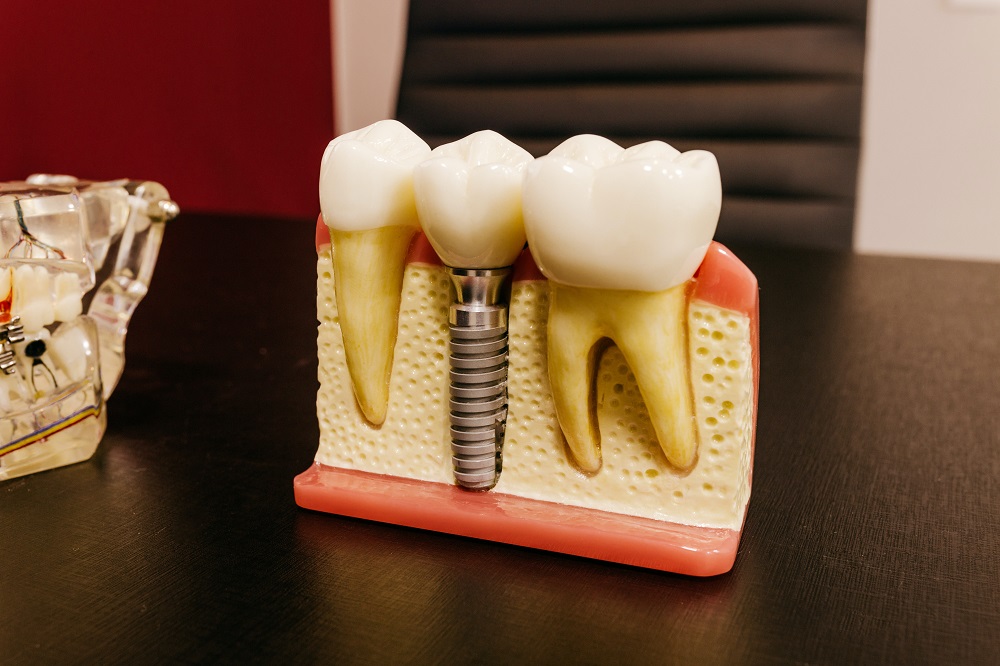
Surgically inserted into the jawbone, the dental implant fuses with the bone in a few months, becoming a replacement for one or more missing teeth. By creating an artificial root with the bone, the dental implant can support either a replacement tooth or a bridge. Being made of titanium, the dental implant effectively fuses to the bone and offers great functional stability, similar to a natural tooth. After decades of great technological advances in the field of dentistry, the expected results from properly fitted dental implants have improved dramatically, with a success rate of 98% of cases.
Why install a dental implant?
Dental implants offer undeniable advantages, especially when compared to current alternative options indicated for tooth replacement. First of all, dental implants are a conservative solution, as they do not touch the teeth adjacent to the missing ones. Secondly, as already mentioned, they offer great overall stability, as they are perfectly fused to the bone structure. Moreover, they can be used to replace a single tooth, several teeth, or all teeth. And finally, aesthetically they present themselves in a very pleasant way, with an appearance similar to that of the original natural teeth.
Which are the alternatives to a dental implant?
There are two possible alternatives to dental implants: dental appliances (full or partial dentures) or a cemented dental bridge (fixed). Dentures are certainly the most economical way to replace one or more missing teeth. But it is not at all comfortable to wear, and certainly does not look very good aesthetically, being removable from the mouth. In addition, the relationship with food is not exactly idyllic.
As for dental bridgeworks, in the recent past they have represented an optimal solution, certainly better than the previous mobile dentures. Leaning on healthy teeth, able to offer the necessary support, they offer greater stability. Over time, however, they may show signs of weakness that may lead to unwanted breakage. However, it is advisable to contact to qualified dental personnel, such as a dental surgeon, who can evaluate the most appropriate solution for your condition. A professional will be able to examine the area of the oral cavity, to evaluate whether a dental implant. A dental surgeon will examine the oral cavity area to determine if a dental implant will solve your problems once and for all.